Online Chess Clock with Live Broadcast
A chess clock is a pair of adjacent timers that tracks each player's thinking time independently. When a player completes their move and presses the shared button, their own clock pauses and the opponent's begins to count down. The first push-button design of this kind was introduced by Thomas Bright Wilson at the London 1883 international tournament, replacing the simple sandglasses that had timed games for decades to speed up the game. Modern digital clocks add features like increments and delays that have shaped how every level of competitive chess is played today. The Wikipedia chess clock article traces the move from analog tumbler clocks to modern digital clocks. FIDE publishes the official rules of chess.
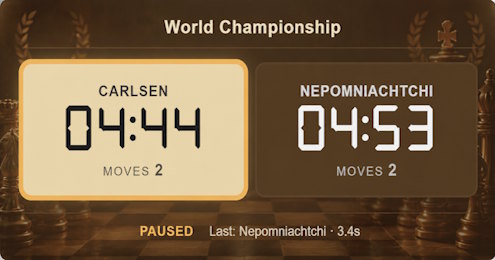
This chess clock is focusing on live broadcast feature. For personal use try the simplified chess clock »
Chess Score Counter Setup
Choose a base time per player and an optional Fischer increment, name both players, then share the live link with anyone watching. On the admin page both players use a single shared control: the Space bar. The first press starts White's clock; every subsequent press ends the active player's turn, adds the increment to their remaining time, and starts the opponent's clock. P pauses or resumes, U rolls back the last press, and R resets the game. Taping a player's panel works the same as pressing space, which is convenient on a touchscreen placed between the two players.
Time Controls
Time control is written as base + increment: the base time is the minutes each side starts with, and the increment is the seconds added to a player's clock after every move they make. 5+3 means five minutes plus a three-second increment.
1+0 or 2+1. Defined by reflexes and pre-memorised opening lines. The most-played format on chess.com and Lichess.3+2 for the World Blitz Championship; online events usually run 5+0 or 5+3.15+10 is the FIDE World Rapid Championship time control and the standard for Grand Chess Tour rapid events.90+30 for the first 40 moves with an additional 30 minutes added at move 40. World Championship matches stack additional time at moves 40 and 60.Basic Chess Timekeeping Rules
Chess Clock History
FAQ
Does the clock add the increment automatically?
Of course. Set an increment in seconds when you create the clock and it is added to the active player's remaining time the instant they press the button. Set the increment to 0 for a sudden-death (no-increment) game.
Can both players share one device?
That's the recommended setup. Place a phone, tablet or laptop between the two players and tap each side's panel (or press Space) to end your turn. The active panel is highlighted so the other player knows the clock is on them.
Can spectators watch the clock live?
Sure, every clock you create has a public live URL without edit controls. Open it on a venue TV, share it with a viewer, or drop it into OBS as a Browser Source for a tournament stream.
What happens when a clock reaches zero?
The board shows the flag-fall and freezes. Under FIDE Article 6.9, the loss is overturned only if the opponent had no possible sequence of legal moves to deliver checkmate, in which case the game is drawn.